Showing posts with label chicken. Show all posts

Monday, February 18, 2013

The Flavours of Yunnan

This winter has been one of the coldest in recent years in Beijing, certainly the harshest since I came to live here almost four years ago. We've had freezing temperatures, snow, rain and the highest, most terrible, unhealthy pollution levels. Many days in the last months, we just wanted to stay wrapped up at home, avoiding going out as much as possible.

One day, I received a package from our friends in Songtsam Lodges (here). The small box had a beautiful bag full of delicious dried Matsutake mushrooms from the mountains in Shangri-la. Memories of our wonderful holidays last summer came back  immediately and as I brought the bag close to my face and smelled it: the earthy, strong fragrance sent me back to the pine forests on the mountains of Yunnan. The whole family had been mushroom hunting with our guide, Dorma, and later we ate a feast of barbecued mushrooms under the stars.


So, back home in Beijing, on a cold winter's night, I made this soup. like most Chinese soups, it is thin and clear, not creamy or heavy but more like a broth or consommé. This is the recipe, with a little bit of help from my friends Liming and Ling.

Chicken and Mushroom Soup (a Chinese classic)

Ingredients
a handful of dried Matsutake mushrooms
3 chicken legs (more flavoursome than chicken breast)
half an onion (roughly chopped)
a piece of ginger, sliced (about 3 slices should be enough, you don't want to cover the mushroom flavours)
water
1 or 2 tbs fresh coriander leaves
small bunch of spring onions
1 tbsp Shaoxing rice wine
seasoning to taste

Method
First wash the dried mushrooms in cold water and leave to soak for a few hours or overnight.
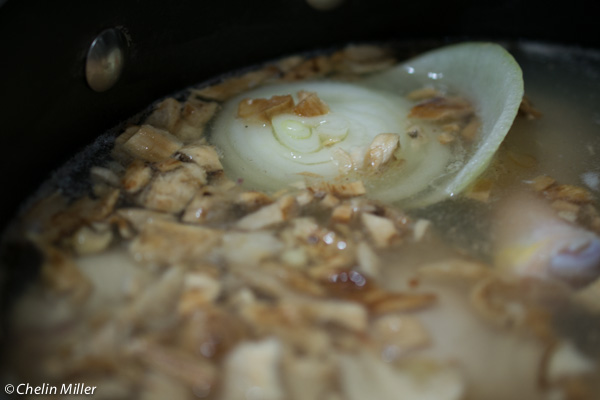
In a big saucepan, put the mushrooms, chicken, onion, ginger and salt to taste. Liming tells me that in Yunnan they would use free-range chickens, but they are not so readily available in Beijing. I should mention that the first time I cooked it, I roughly chopped the mushrooms, but their shape is so pretty, that the following times I left them whole.
Cover with cold water and bring to a quick boil. Bring the heat down to low, skim off the scum with a strainer and let the soup simmer for about 1 hour or until the water is reduced by half. If you want, you can remove the chicken from the liquid and after leaving to cool for a little bit, remove from the bone and skin and return the shredded pieces to the soup.
To finish off, remove from the heat, add Shaoxing wine rice (optional), coriander, green onions, pepper, adjust seasoning, and serve.

dried mushrooms straight from Yunnan

mushrooms, chicken, onion, ginger and water to begin with

skim off the scum with a strainer 
beautiful shape

If you are interested in our adventures in Yunnan - The Kingdom South of the Clouds, you can visit my other blog postings here:
Buddhist Basketball
Little wild flower of Yunnan
Last Hidden World
Tibetan Buddhism prayer flags
Yunnan mooncakes

Tuesday, October 16, 2012

The Food of China - Real Chinese Food


On a recent visit to England with my family, we were craving Asian food, so we decided to buy some ready-made Thai and Chinese meals at Tesco's. I was horrified when I tried celebrity chef, Ken Hom’s supermarket version of Kung Pao chicken because although I was not expecting it to be haute cuisine, the dish did not resemble the original a bit. Although the dish was flavoursome, the chicken was tender and cubed in uniform-sized pieces and it had a good, colourful appearance, it tasted more like a thick massaman curry than Sichuanese Kung Pao – I suppose this was due to the addition of some kind of peanut paste for flavour rather than real, crunchy peanuts. I was disappointed, and although I have followed Ken Hom since the 90s (I've even had a wok from the KH brand since then that I still use!) I realised that it will be difficult to find ‘the real thing, real Chinese food’ when I move out of Beijing. I know I will miss it so I have made a point of learning some traditional recipes. In the process, I have become fascinated with the Art of Chinese Cuisine.

China is a huge country, with an ever-growing population to feed and a diverse climate and geography. Even within China you will find different variations of your favourite dish. China also has many neighbours that bring their own culinary influence (Vietnam and Myanmar to the South; Nepal, India, and the ‘Stans to the West; Russia and Mongolia to the North; Japan North and South Korea to the East). It is a country that covers all kinds of landscapes and climates: from tropical monsoons, to arid deserts, luscious, bamboo covered jungles, and the highest mountain ranges on earth. With such diversity, China’s cuisine is bound to be extremely varied, too. China has one of the great food traditions of the world and eating plays an important role in daily life, rituals and festivities.

In Western countries, when we think of Chinese food, images of egg fried rice, spring rolls and chow mian come to mind, because we have been mainly exposed to Cantonese food, which is but one of the many regional cuisines. Generally speaking, and not to overcomplicate the classification, there are eight major regions in Chinese cooking: Shandong, Anhui, Zhejiang, Guangdong (Hong Kong, Cantonese), Hunan, Sichuan, Fujian and Jiangsu. Food regions can also be divided into cardinal points: the food of the North, East, South and West. 

One of the main perceived divisions within the country is between north and south, which runs roughly along the Yangtse river. This imaginary boundary is supported by the idea that culturally (and not just culinary), the two regions have two different identities. The staple food of the south is rice - white and polished grains, usually steamed. But rice doesn’t grow well in the harsh climate of the north, where wheat, maize and millet are grown as staple and made into breads, buns and noodles. 

I wrote some impressions on 'the man of the north' on a recent post in my blog about life in China (see here)

The real Kung Pao chicken, cooked at "Black Sesame Kitchen"

I have a new project in mind: I will be exploring the different regional cuisines of China and reporting back on my findings and impressions, but for the time being, I will share a recipe for 'the real' kung pao chicken, adapted from a cooking lesson that I took at Black Sesame Kitchen, a cooking school in Beijing (see link here).


Kungpao Chicken 宫保鸡丁

300g chicken thighs, deboned (or chicken breast) cut into cubes
1 tsp salt
100ml water
1 tbsp cornstarch
1 tbsp oil
oil for stir-frying
1 tbsp Sichuan peppercorns
a handful of dried chilies (to taste)
1 tsp chilli flakes
1 tbsp each, leeks (cut into 1 cm squares), ginger and garlic (chopped)
1 red bell pepper, cut into cubes of a similar size to the chicken

Sauce:
1 tsp cooking rice wine
1 tbsp Shaoxing rice vinegar
1 tsp dark soy sauce
1 tbsp light soy sauce
salt, white pepper, to taste
2 tbsp sugar
2 tbsp water
2 tsp cornstarch
5 tbsp cooked peanuts (deep or stir fried in advance)

To tenderise the chicken, cut into cubes, season with salt and add to a bowl with water, making sure the liquid is absorbed. Add cornstarch and coat well.

Heat some oil in the wok until hot enough deep fry the chicken, making sure it doesn’t stick together. Cook for about 1 minute. Remove the chicken from the wok and set aside.

To infuse the oil with spices, heat the wok and add a little oil. Add Sichuan peppercorns and allow them to infuse in the oil taking care not to burn. Once the fragrance is released (approximately 15 seconds) remove the peppercorns from the oil. Then add dried chilies and toss for 5 seconds.
Add chili flakes and stir for 2 seconds and then add leek, ginger, garlic and bell peppers and stir-fry for 1 minute. Add the chicken back into the wok and toss for another minute.
Spoon the sauce mixture over the chicken, mix thoroughly and let it cook for a couple of minutes. Add the peanuts, toss and serve.